28.6.12

GHOSTS N' GOBLINS (Capcom, 1986)

Back in the early ‘80s, Eddie Murphy did a brilliant bit of stand-up, based around his rather blunt theory on female abstinence.
Women, he claimed, will happily withhold certain ‘favours’ from their men, in order to maintain an ongoing sense of loyalty, interest and commitment.  Said favours are bestowed only when the men have worked themselves up into such a frenzy of anticipation that they’ve lost all sense of value and perspective... at which point the cage swings shut (he had a name for this theory, which I won’t go into here – suffice to say, it’s a euphemistic variation on the Venus Flytrap).
Basically, he says, it’s like giving a starving man a cracker.  “GODDAMN!!” he shouts.  “THAT’S THE BEST DAMN CRACKER I EVER HAD IN MY LIFE!!  THAT WEREN’T NO REGULAR CRACKER, WAS IT?  WHAT WAS THAT, A SALTINE?  A RITZ?  JESUS, THAT’S THE MOST GODDAMN DELICIOUS CRACKER I EVER ATE!”
And so you give him the whole packet.  You give him forty packets.
And then, six months down the line, he reaches that moment of clarity:  “hmmm.  I just got some regular old crackers.”
Now, when it comes to Ghosts N’ Goblins – my first ever computer game - I can relate to this.  It wasn’t exactly like I was ‘starving’, but my best mate had a BBC Micro, and I must have been ferrying home some very excitable stories about Jet Set Willy and whatnot.  On top of all this, I was fortunate enough to have some very intuitive parents.
So on Christmas morning, 1988, I tore away the wrapping from my first ever computer, unsheathing the mighty Commodore 64 (albeit a temperamental, second-hand Commodore 64, a machine that was borderline French in its propensity for tantrums and shit-fits).  With that computer came two games – Ghosts N’ Goblins, and Summer Games II, which was a tie-in licence with the Seoul Olympics.  I may only have been about seven at this point, but I’d long-since cottoned on to the fact that I didn’t like P.E very much.  So I ended up popping my gaming cherry with G’N’G.
Now if there’s one thing that’s put a consistent strain on my parents’ marriage over the years, it’s my dad’s refusal to read – or even acknowledge – instructions.  Having successfully wired a plug in 1973, he’s since considered the installation / operation of anything electronic to be a combined matter of luck, instinct, and educated guesswork.  Under strict orders, he’d been dispatched to my cousin’s house on Christmas Eve to pick up the C64, test it, and find out exactly how it worked: when he did finally saunter his way over at about 8pm, he’d basically spent the whole evening quaffing liqueur chocolates, and playing with their Labrador.  “How hard can it be?” he’d have asked, cracking open another beer.
When he finally came home, he’d fallen asleep in front of Jaws.
I can still remember my mum’s lips thinning to the point of invisibility when, on Christmas Day, it wouldn’t work.  It was one of the longest days of my life; him hunched for hours in front of the TV, her glowering thunderously at him, and me, riddled with that same kind of idiot anticipation Eddie Murphy had described.  I’d been waiting for this moment ever since my first go on Jetpak at Rory’s house: as I sat there cross-legged, building a Lego castle, I’d already decided that whatever Ghost N’ Goblins had to offer, it was going to be awesome.  The trap was primed.
In the end, something – be it the Spirit of Christmas, or my mum’s smouldering voodoo ill-will – got it working.  There’s few grander moments in life than the snowstorm static of a TV screen cutting to whatever it’s supposed to be showing... and there, suddenly, it was; white words on royal blue, bordered thickly in pastel, the command cursor blinking at us like the drumming of fingers.  And so it all began – the cage swung shut.
I’ll be honest here – I was (and am) willing to believe that G’N’G was a lot better than it actually is.  In this case, I think, it’s more about what it represented than anything it actually had to offer; that first taste of the primal magic of gaming.  It was one of those gateway moments that are so easily identified in hindsight, but don’t always announce themselves at the time.  It’s hard to put into words.  I suppose it’s a bit like your first football match, or passing your driving test; you know you’ve discovered something that’s going to have an immeasurable impact on your life, stretching far off into the coming years.  And even at the age of seven, I clearly remember that thrilling realisation thwacking right into me.
It was all so utterly, completely awesome.  The loading screen, the title screen, the solemnity of the music (a rather atmospheric rendition of Chopin’s ‘Prelude No. 20’)... G’N’G lassoed together everything that used to be great about computer games.  It triggered an imaginative response, you see; it all hinged on the vibe, which it delivers in bucketloads from the outset.  Yes, history and progress can fling their glares down now upon the graphical capabilities of the C64, but to me, at that point... wow.  That whole game looked like it had been chiselled from the ceiling of the Sistine Chapel.
And then I actually played it.
Which went something like this:
“OK, let’s see what we’ve got here, I’m this knight guy, apparently, and I can go left and right... ooh, look, I can jump up and d... Oh, I’ve died.
Righto, try again... oh, look at that, he shoots out swords or something, they’ll be useful for killing those zomb... oh, they come from behind as well, do they?  Bugger.  Start again.
Third time’s a charm... kill him, kill him... jump over this tombst... Hang on, I can go forwards, and I can jump, but I can’t jump forwards.  And – ha ha – dead again.
Right, I’m getting the hang of this now.  Kill, kill, jump, kill... oh look, a spooky bird, perched impassively atop another tombstone!  No, hang on, that’s some sort of surface-to-air mega-crow, I can’t duck it OR jump it, and... oh, for Christ’s sake.
OK, this time, I’m just going to inch my way along, nice and careful, nice and slow, over the tombstone I go... so what if it’s taken me three minutes to get past the first screen, I’m alm... you what?  They’re timing this insanity?  As if this madness wasn’t enough, they’re putting me up against a clock?!
What do you mean, ‘game over’?!”
And therein lies the problem with Ghost N’ Goblins, the inevitable yin to its yang of new dawns and excitement, and all that good stuff... it’s just unplayably difficult.  I mentioned ‘popping my gaming cherry’ earlier – this wasn’t some tender, gentile, twilight fumble with a first love.  Breaking yourself in with G’N’G was like being choke-slammed onto a pile of house bricks; like having some towering bondage queen punching you hard in the nuts, over and over again.  It’s a perfect storm of unresponsive controls, ropey collision detection, and a prohibitively steep learning curve.  It was a wholly unforgiving game... even moreso for a cack-handed 7 year-old like me.
It still didn’t quell my fascination, though.  I’m also slightly consoled by the fact that Gametrailers.com have since declared G’N’G to be the second hardest game of all time. I played it again, years later, armed with all the accumulated benefits of age and experience, thinking I could set about exorcising a few demons... a bit like Tom Hanks in Big.  It’d been bothering me for years, and so now – as a grown man – I was going to vanquish this insoluble beast of a game, flush it straight to Hell and finally move on.  No chance: it dutifully handed me my arse on a plate, once again.  Some games tend to soften with time, as your motor skills and your cognitive abilities sharpen up; G’N’G remains one of the most difficult things I’ve ever encountered, and I include within that A-Levels, falling (and staying) in love, negotiating a mortgage, and the pre-entry interview for Cambridge University.  From start to finish, the whole thing is an absurd, brutish monument to difficulty; a ridiculously hostile experience.
Games used to be like this, though – there wasn’t the commercial imperative to cater for the incapable and the stupid.  The average game of Pacman or Donkey Kong only lasts for something like three minutes; as I recall, adjustable difficulty settings didn’t even come into vogue until the days of 16-Bit.  Simply, G’N’G was what it was, and if you couldn’t cope... well, that wasn’t really Capcom’s problem.
That kind of programming comes with its own rewards, I suppose, because (certainly in the C64 days) I never came close to completing at least 70% of the games that I owned.  These were the prohibitively difficult ones like G’N’G, the games that rewarded the zealots and completionists, those truly committed souls that made skylines from the teetering columns of tapes stacked against their bedroom windows; I wasn’t one of them, so instead I had a shelf full of games just like G’N’G, all rife with the tantalizing prospects of the things I hadn’t yet seen, or conquered.  Each one its own little curiosity, flicking Vs down at me from the bookshelf.
It’s not like that anymore; nowadays, there’s not just a belief, but the actual expectation that having paid your money, you’re going to get to play a game through, from start to finish.  Implicit within that is a commitment from the player... and I think that’s partly why it feels like I’m coming to the end of my gaming life.  We’ve only got one tele in the house, and I simply don’t have the time or the inclination to muster that kind of investment, to sign up to it all at the very start, not when everything seems to be so self-consciously grand.
But I find myself wondering if it really is a practical issue, or the fact that the games just don’t seem to capture my imagination anymore.  I think, for example, of the difficulty I’ve had in getting properly into Skyward Sword; it’s been sat there since Christmas, virtually untouched.  Equally, I think back to the hours and the effort and the sheer fascination I committed to this single, curmudgeonly game, back in the day.  In a weird way, the developers’ insistence on filling in all of the gaps, on crafting a coherent and completely defensible gaming world, means that we don’t tend to get games like G’N’G anymore; games that were forged within and in spite of their limitations.  And therefore, because there’s no gaps, because everything’s so remorselessly logical, we don’t get to imagine anything.  There’s no need to paint your own picture anymore - we’ve strayed from the intangibles of gaming.  And that’s a shame, in much the same way that The Twilight Zone is always going to be a damn site creepier than the Saw films.  Like Alonso Harris says in Training Day, "it's not what you say, it's what you can prove."
Ghosts N’ Goblins... yeah, it’s fine.  It’s OK.  It probably triggered my subconscious love of ‘things n’ other things’ (Guns N’ Roses being an obvious example), but that’s about it.  At the end of the day, it was just some regular old crackers.  Representatively, though, it meant so much more than any of that; I finally owned a computer.  And I knew then that in the years to come, I would probably own other, better computers, playing – and totally losing myself within – hundreds of other computer games... just as willingly as I lost myself in those first two or three minutes of Ghosts N’ Goblins.  I remember going on the Monorail at Disney World for the first time, in 1990 - fun, exciting, and very memorable, if only for what it was taking me towards...  And that’s why G’N’G will forever be sanctified in my mind as that first point of contact.  The crossing of a threshold.
Or in Eddie Murphy’s world - the bait.

14.5.12

SUPERMAN (Taito, 1988)

Poor old Superman.  Computer games really haven’t been kind to him.
Having already gushed over the likes of Sonic and Zelda, I felt that in the interests of fairness, it was only right to flag up something a little less... accomplished.  Something a bit less auspicious.  Something that - in this particular case - wasn’t just bad, but memorably bad.
And that’s a distinction of sorts, I suppose.  Just like the Police Academy films, it’s that kind of notoriety that, in some ways, makes a game great.
And in other (more accurate) ways, reeeeally doesn’t.
Thinking back, it’s a toss-up between which piece of work more spectacularly failed to do its subject matter justice; Taito’s Superman, or my Year 8 Geography project on Euro Disney (400 words, no pictures, and written during two non-consecutive bouts of diarrhoea).  Superman probably just about sneaks it, as for all the ways in which it’s crap, it is at least definitively crap.
History is replete with examples of the sum falling hopelessly short of its component parts.  Mick Jagger and David Bowie’s unprovoked assault on ‘Dancing in the Streets’, for example.  Everything about that worked, on paper.  In a similar way, and whilst it really shouldn’t have been, Superman was appallingly bad.  And that’s saying something, because when you’re young, computer games – and arcade games, in particular – are all just supposed to be unilaterally awesome.
Two of my great passions growing up were computer games and stadium rock.  Thinking about it now, sideways-scrollers went the same way as glam metal, at the same time, for just about the same reasons; they were colourful, and they were brash, but for the most part they just didn’t have any bollocks.  There was no real soul there.  And so, for every Final Fight / Guns N’ Roses, there were a hundred Superman / Poisons.  The same mechanics, the same concepts, the same engine, all repeating to a terminal fade.  Superman – stupid, lazy, thoughtless Superman - was one of the main symptoms of that particular malaise:  what it did at least do, I suppose, was announce and embed some of the genre’s clichés, before they’d had actually the chance to become clichés.
Now before we get into this, just think for a moment of what the Man of Steel has to offer, from a purely developmental point of view.  Flight, super-strength, near invulnerability, super-speed, X-Ray vision, telescopic, infra-red and microscopic vision, super-hearing, super-breath... The guy can fly into space.  The guy once circumnavigated the globe so quickly, he actually reversed the passage of time.
He survived a nuclear blast.
He has flown into the sun.
“Faster than a speeding bullet!” goes the tagline.  “More powerful than a locomotive!  Able to leap tall buildings in a single bound!”
Or, judging by Taito’s interpretation:
“Slower than generic street hoodlums!  Easily damaged by bins!  Struggles with fences!”
Even in the rosiest hues of nostalgia, even squinting through the myopic fog of Happier Days, Superman just sucked.   It was an abominable mish-mash of inconsistencies, hellish monotony, and some almost Dadaist non-sequiturs.  Unravelling across five stages – ‘Metropolis’, ‘San Francisco’, ‘Las Vegas’, ‘Washington DC’ and ‘Space’ – it’s less an arcade game, and more an attempt to test a) the limits of human endurance, and b) how many gallons of urine Taito could spatter upon the legacy of America’s favourite comic-book son, presumably without reproach.
The immediate and very obvious problem with Superman is that he / it could barely have been less ‘super’ if he / it had tried.  When you’re playing a game with Superman in it, ‘super’ is something of an engrained expectation.  Here, he basically looks like a bloke who’s looked after himself reasonably well, and just happens to have the ability to hover indefinitely.  Rarely has a video game superhero looked less remarkable.  The alleged ‘Ultimate’ Muffin I purchased from a Tesco Express last year delivered more authoritatively on its promise.
I mentioned sideways-scrollers earlier... Games like Final Fight worked because, when you’re dealing necessarily within a loose sense of realism, you can get away with just a ‘kick’ button, and a ‘punch’ button.  It’s all grounded in the nitty-gritty and the grime of a organic street battle.  You’re looking for a bit more from Superman, though.  Heat-emitting vision and stuff.  And even then, when he does, say, ‘kick’, it’s not some mighty mule kick, it’s not a vicious roundhouse to the chops; he looks like a Victorian beach spiv shoeing sand into the face of a rival lover.  When he punches... Christ, I’ve posted letters with more ferocity.
Oh, but hang on, what’s this – if you hold down the punch button, he unleashes some sort of prototypic, Streetfighter-style energy ball across the screen... which – with an almost admirable disregard for continuity – is just about the only thing Superman has never done.    And that’s just one of the sad, illogical shrugs that Taito flung into Superman, a game programmed with an almost visible sigh.  What next?  Spiderman summoning the Batmobile?  The Silver Surfer enlisting the help of his friend and ally, Pedro the Uncircumcised Mule?  Like John Goodman asked in The Big Lewbowski, “am I the only person who gives a fuck about the rules?!”
From the very start, Superman plays like a murder-suicide pact between Continuity and Attention to Detail.  Just pick your mistake; they come bursting immediately to the surface, like some demented game of Whack-a-Rat.  Maybe it’s the cooperative mode, where the ‘second’ player rocks up wearing red and grey, like some sort of mental Superman away kit.  Maybe it’s the Las Vegas level, and the ‘COSINO’ in the background?  Ambling through a space station, fighting off anthropomorphic pink bunnies?  Or San Francisco, where Taito rejected every single identifiable landmark at their disposal – Alcatraz, the Golden Gate Bridge, Lombard Street – instead focussing almost 70% of the level inside the city’s world-famous... sewers.  And is if that wasn’t bad enough, once you’ve descended for what seems like three vertical miles, you come face to face with... a helicopter!  Underground!  Which you literally have to punch to death!  And all this whilst you’re slaloming through meteorites, that appear to be falling from NOWHERE!
The biggest triumph, though - the geographical clusterfuck par excellence - is the Washington DC stage.  Here, Taito at least made an effort towards some sort of contextualization, as Superman progresses past a slew of famous landmarks , including the Lincoln Memorial, the Washington Monument, the White House, and finally... Mount Rushmore.
That’ll be the Mount Rushmore in South Dakota.  1,400 miles away.  Why not, though?  All bets are pretty much off by this point.
Where is Lex Luthor?  Where is Bizarro, and General Zod?  Why are you instead pitched against an inexhaustible supply of Turbo-Men, from Jingle all the Way?
Ultimately, Superman does for continuity what Salvador Dali did for right angles.  And that’s the puzzling thing, because really, who’s your primary market for a game like this?  First and foremost, you’d assume, it’s Superman fans.  And it’s a fair guess that this group is going to overlap not inconsiderably with your generic comic book nerds, and comic book nerds are not exactly known for their tolerance of continuity errors.  Seriously, guys – did you really think you’d get away with it?
To be fair, this was the 1980s, back when nobody really paid attention to anything.  I can only assume that having unsuccessfully pitched Ricky Raccoon’s American Adventure in Space to some sniffed-up Taito executive, the developers slunk off, returning 50 minutes later having slapped a Superman sprite in Ricky’s place.  Kids don’t like raccoons.  They like Superman, and helicopters,” the boss would have bellowed at them, like the editor of The Daily Planet.  That’s the only possible explanation for the tides of incongruity swamping this game, because the Man of Steel is the only thing in the midst of this irredeemable tosh that could’ve possibly merited the licence.  I’ve got images of Jerry Seigal and Joe Shuster, the creators of Superman, sat in the development meeting, heads in hands, one of them perhaps pinching the bridge of his nose, the other thumbing his temples.
As I recall, Superman found its home in many a cinema foyer, and I suppose in this sense achieved a fleeting moment of usefulness; a vapid bit of fluff, the video-game equivalent of talcum powder, there to soak up the minutes between buying sweets, and waiting for Ghostbusters II to start.  Only 9 year-olds – with their sugary enthusiasm, and anorexic attention spans - could have stomached this... but even then, back in the day, I remember having some pretty strong inklings as to exactly how crap Superman was.  No – not even the most determined of nostalgics could whittle something worthy out of this.  A career revisionist couldn't alchemize this into something decent.  Because at the end of the day, there’s got to be something noteworthy there.  Something of value.

I mean, at least Police Academy had tits in it.

30.4.12

THE LEGEND OF ZELDA: OCARINA OF TIME (Nintendo, 1998)

I was a very neurotic little boy.  Very neurotic indeed.  I used to think about things – everything - one, two, three times.  It comes from being an only child, I reckon: too much time stuck in your own head, your thoughts jostling around all over the place.  It reminds me of that scene in Spinal Tap, when the band go to see Elvis’ grave.
“Puts it into perspective, doesn’t it?”
“Too much.  There’s too much fucking perspective.”
There was lots of perspective, and lots of neurosis, back in 1999.  There were mock A-Levels, and actual A-Levels.  There was the dawning realisation that I was about to be flung from the cozy little alcove I’d dug out for myself, off towards a university, Somewhere Else.  Forest were in the midst of getting themselves relegated, again.  And perhaps most significantly of all, I'd just turned 18.
I finally left the velveteen womb of childhood on the 9th of February, 1999.  There was a huge, clamorous party – two or three of my other friends celebrated their big days in February, too – at the Beetroot nightclub: someone even cobbled together invitations, on purple paper no less, which gave the whole event an ill-deserved veneer of exclusivity and grace (I say ill-deserved, as between them, my mates invited the bulk of the English speaking world, a lot of whom just ended up fingering each other).  All night long, as the Tamperer continued to ask what she was going to look like with a chimney on her, I just couldn't shake the impression that my presence there - as a devoutly serious and rather limp young man - was rather... well, incidental.  In fact, I was pretty certain that inviting me to my own birthday party had just been a discreet means of thinning out the deposit.
We’d hired out two floors.  Unfortunately - and unbeknownst to us - they were the first and third floors: the second was hosting the AGM for the Nottingham Gay Alliance.  I spent the whole night pulling glumly at a bottle of Reef, in the company of people I (at best) didn’t know or (at worst) didn’t particularly like, ducking out for an occasional breather to see what the gays were up to downstairs.  I remember standing outside at the end of the night, glazed in the watery electric heat of a purple neon sign and waiting for a cab, wondering just what the hell was going on.
But I digress.  Whilst that was the most memorable thing about 1999 (that, and Robbie Williams' delusions of rock stardom becoming briefly, terrifyingly real), the second most memorable thing was playing The Legend of Zelda: Ocarina of Time.
Of course, with the benefit of hindsight, I’d jump into my DeLorean now, and go back to those final months, the January to May period curtaining off my childhood: I’d tell myself to put down the N64 controller, and go and kiss some girls or something.  Go and earn yourself some hangovers.  Relax, I’d say.  In twelve years' time you’ll have long wavy hair, and a house, and a beautiful fiancé.  You’ll get to wear suits all the time, and generally walk around looking shit-hot.  You’ll still over-think everything, to be fair, but only because you’re getting paid for itOh, and McDonalds don't do sachets of mustard anymore, so enjoy that ride while you can.
By early 1999, with a phalanx of Big, Defining Moments tumbling over the horizon almost every week, Zelda was the only thing in my life that wasn’t poking me in the ribs, reminding me that I’d perhaps not come as far as I should have.  I got it for Christmas, and once it had gotten under my skin - after the first unconvincing fortnight of wandering around Kokiri  Forest, forward-rolling into trees and flinging shrubs at the village-folk - I was hooked.  From that point onwards, Zelda was the centrepiece of a private, self-conscious pledge; to enjoy whatever childhood I had left.
To paraphrase the Ramones, I didn’t wanna grow up: this game was my enabler.
Zelda is acknowledged in many quarters - justifiably I’d say - as The Greatest Computer Game Of All Time.  Kind of in a Beatles way; there’s been better produced, bigger selling games since, but it nonetheless has to be understood in the context of what was around at the time, and everything else that it ushered forth.  I played it recently on my mate Steve’s 3DS, and even with the 3D effect mimicing life after fourteen pints of Mild, the game’s lost absolutely none of its lustre.

It’s a simple story.  As ever, you are Link, a sort of pre-ordained heavenly wood-elf, who comes to understand – across the course of an epic, unravelling, time-travelling narrative – his place as the Chosen One, delivering from evil the land of Hyrule.  We open with troublesome dreams, and clapping thunder, and Princess Zelda managing to once again get herself kidnapped (which is pretty much a prerequisite of Nintendo's princesses).  And lo, Link the warrior is born, and much of what follows is...
Blah blah blah.  Ultimately, to reduce Zelda to a simple plot is like saying It’s a Wonderful Life is just about Christmas.  This is a game about life, and growth, and exploration.  It’s about learning, and connecting tangibly with the world and people around you.  And for a computer game released in 1998, this really was something of an achievement.
It was the first game I remember offering up a sincere, considered and workable sense of freedom.  Because once you really started making headway in Zelda - after the game had taken your hand and ruffled your hair, easing you through some remedial chopping / shrub-throwing exercises - you’d have to wander a long, long way in order to find a border, barrier, or proverbial brick wall.  What Zelda does so peerlessly is to wrap up a fairly conventional ‘saving the princess / world’ narrative in the fantastical mechanisms of a lavish, distant (and yet altogether human, and believable) world, a world engineered to reward curiosity and exploration.

The central plot of Zelda is an obligation, but never a compulsion: you'll spend most of your time wandering, exploring, returning, reassessing, and conversing.  Catching fish and chasing chickens.  There's a massive streak of casualism hewn deep into the guts of Zelda, right up to the very end: even when you've progressed to the pinnacle of swordsman, when you're striding about Hyrule as a double-hard bastard, you'll find yourself irretrievably drawn to some pointless favour for an old crone in a shack, collecting bugs in a jar or something.  With day and night cycles, the eponymous teleporting ocarina, horseback riding, the ability to move seamlessly backwards and forwards through time... movement is easy, fluid.  And because of that, the whole game’s underpinned by the expectation that you won’t just go ploughing through it; that you’ll take the time to meet people, and explore, and understand this foreign world of Hyrule.  There’s none of this eventless trudging through five minutes of looped scenery, meandering back from point B to point A just because you forgot a potion or something.
The GTA series and other non-linear games owe an enormous debt of gratitude to Zelda.  100 hidden collectables?  Seemingly inconsequential sub-games and tasks, that end up as integral to your progress seven years down the line?  Discovering new pieces of equipment, acquiring new skills, and returning to previously inaccessible locations?  Check, check, and check.   Zelda was the tipping point that clued developers up to a realization that an engaging and immersive gaming world was reward in itself; that if it’s lavish and expansive enough, if it’s believably a world, and not just a structured progression of levels or challenges, then it will hold people's attention.  And that’s how Zelda - revealing itself in these delicious little increments - devoured so many of my afternoons, and evenings, and weekends, when I really should have been out getting drunk.  Or at least revising.
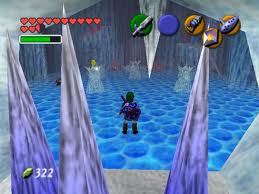
With Zelda, Nintendo spun a juicy array of dimensions, environments, climates and aesthetics around what is a thematically quite a simple and linear game – what contributes to the sheer scale of the game is how distinct and how engrossing the developers managed to make each one of its component parts.  Melding seamlessly and instinctively with the control pad, and discovering in the process a practical use for the N64’s thumbstick (which was no mean feat  – most of the early N64 games demanded Olympic-standard ambidexterity), Link walks, runs, rolls and jumps through some fabulously visceral environments and climates.  There’s bustling towns, and meandering mountain ascents; cavernous shrines and temples; parched, dusty wastelands, and oppressive, simmering volcanoes; crystalline caves, and fetid dungeons.  There’s fire, ice, water, forests, deserts, and even a dab of spacey, ethereal weirdness... what’s so impressive about the universe Nintendo engineered in Zelda is that in an indescribably tangible way, each place exists in and of itself, hugely impressive and memorable in its own right, so vibrant you can virtually feel it.  They moved away from the thoughtless, superficial fluff of other adventure games: here, it’s not just that the icy bits are slippy, or that the hot bits are redder than everything else, it’s the interactive attention to detail, the evocative packaging that generates a pervasive sense of hot, cold, wet, dry etc. 

The other noteworthy thing about Zelda was its fabulous soundtrack.  Unfortunately, this passed me by almost completely, as through a processing error at the Britannia Music Club I’d come into possession of Fantastic ‘80s Volumes 2 and 3 (instead of Ozzy Osbourne’s No More Tears): rather than Koji Kondo’s touchingly evocative score, Zelda for me is now umbilically tethered to Toni Basil, the Bangles, and Transvision Vamp.  Although to be fair, nothing compounded the emotional resonance of galloping across Hyrule Field quite so effectively as Cyndi Lauper’s ‘I Drove All Night’.
Zelda was the last game I ever played through a kid’s eyes: fittingly, it was the last game I can ever claim to have completely lost myself in.  It was a game that seemed to be, from the very outset - from all of the excitable articles, and the previews, and a universally captivated press - penning its own legend.  Reinforcing its own myth, in real time.  Games magazines went mental over it.  As an N64 owner, having it was a matter of almost religious significance.  And if you weren’t an N64 owner... well, you’d bloody well go out and get one.  Many did, such were the accolades.  Zelda did for the N64 what Super Mario World had done years previously for the SNES – it gave it a sense of exclusivity.  And not like a misspelt purple ticket for a sanctioned orgy - I mean meaningful, marketable exclusivity.
I’m not doing it justice really, because to lavish Zelda with the detail and discussion it deserves – baring in mind the scale of its innovation, its sheer beauty, the mesmeric need to conquer it - would take many, many pages.  Suffice it to say, if you’ve never played it before, do so.  Immediately.  Manageably epic, sensibly vast, it stands astride the threshold of sandbox gaming, as an unparalleled example of the genre (before it all got slightly too clever for its own good).  It’s an unbelievably rewarding and compelling experience, and it’ll quickly have you hooked beyond all hope.
The Legend of Zelda: Ocarina of Time was a cathartic, immersive and memorable distraction in the midst of some considerable turmoil.  When I wasn’t playing it, I always seemed to be edgy, and nervous, and churning, my anorexic sense of self-esteem colliding with an impending sense of growing-up, and change.  So in a bittersweet way, I’ve always cherished and celebrated Zelda as a sort of self-conscious swansong for my childhood.  It’s strange, looking back: that kind of perspective tends only to reveal itself in hindsight, but I was absolutely aware of it at the time - this End of Days, this conclusion.  Hence the special place it continues to occupy for me to this day.
I’ll close with another thing that happened in 1999: the release of American Pie.  I remember watching it at the pictures and just thinking yeah, righto.  All those cheerful, scrappy, gorgeous Yanks... growing up for me – and a few others, it turns out - was just a matter of jarring biological necessity, and those final months of mountainous self-realisation just rammed home exactly where seven prurient years of single-sex public schooling had got me: pathologically afraid of girls and hangovers.  Zelda was the standard-bearer for my own personal resolution, to enjoy what little remained of being a kid.
And there it remains today, slightly dusty, holding hands with Billy Ocean on the one side, and the diminishing simplicities of childhood on the other.  Gawd bless it.


12.3.12

FINAL FIGHT (Capcom, 1989)

Given that it was a fixture of every single leisure centre in Britain between 1989 and 1991, the first thing Final Fight conjures for me is the smell of chlorine.  It’s quite strange, in fact, to play it now without the accompaniment of squeaking plimsolls, the shrill of a lifeguard’s whistle, or the sound of Coke cans thundering around the guts of a vending machine.

In a nutshell, Final Fight is a bit like an interactive John Carpenter film.  It’s a sideways scrolling beat ‘em up, set in the fictitious Metro City, which – like every other generically ruinous city featured in 1980s computer games – is supposed to be New York.  There’s lots of doomy synth, and lots of broken buildings, underlit barrooms, and the obligatory subway trains drenched in graffiti.  This is exploitation-era NY – the pre-Giuliani one - full of pimps, pushers and thugs, sliming around every corner.  Everything looks dented and slightly filthy: just imagine a glossy, cyberpunk mash-up of Akira and Escape From New York, pebbled with the pop-culture kitsch of the day, and you're there.  It's what computer games would look like if Billy Idol designed them.

Originally marked as the sequel to Street Fighter, Final Fight was more like Double Dragon with a load of growth hormones wedged up its arsehole.  Instantly one of my favourite games ever, I remember it standing clearly astride the busy and unremarkable genre of sideways scrolling beat ‘em ups.  There’s little that’s remarkable or unique about it, but it was a fantastic spit n’ polish job on a rather humdrum genre, very much the Ferrero Rocher of its day.

I was fascinated with Final Fight; I still am, in a way.  I adored it.  It was a standard bearer for the salad days of arcade games - fantastic, bemuscled things, that cast a long and withering shadow over anything your own computer could muster.  Dutifully, someone like US Gold would always have an optimistic jab at porting them to your C64 (see left), but for all your hopes and dreams, they were never anything more that blotchy, cave-painting approximations of the beasts that had gobbled up all of your pocket money.  The Mega CD version was supposedly the best effort, but I only had one friend who owned a Mega CD, and he was the subject of a ferocious custody battle: as I recall, it’d been bought by his dad to lassoo attention away from his chronic drinking, and even to me that seemed an uncomfortable trade-off.  The SNES version was missing one of the main characters.  The 8-bit versions... well, the less said about those, the better.  They looked like a retard’s dalliance with neo-cubism.

No, if you wanted to experience the full, unfettered pomp and glory of Final Fight, you did it with a pocket full of twenty pence pieces, as God intended; anything less was like your mum promising you a McDonalds, only to spend forty minutes in the kitchen jabbing at a splodge of charred, spitting meat, and then bizarrely claiming that what she'd done was “even better.”

So what if Final Fight’s impossibly difficult?  So what if there’s nary an original thought or concept contained within?  And so what if it’s choc-full of weird and illogical non-sequiters, like phone boxes that crumple under a single punch, and turn into apples?  Final Fight was a burly knee-trembler of a game, where progress was so prohibitively expensive that you were doomed to play only the first two levels, over and over again.  But lordy-loo, what a compelling couple of levels they were.  Like a peep show in the 1930s, that one glimpse was a damn site better than anything you were ever likely to see at home.  It was thrilling.

The plot (and I use that word in the truest spirit of charity)... You have to rescue Jessica, the Mayor’s daughter, who - for reasons best known to the Japanese, and their ceaseless penchant for submissive women - has been tied up and stripped to her bra.  To do this, you take your pick of three characters:  Haggar, (Jessica’s dad, and the Mayor of Metro City), Cody (the all-American boy), and Guy (some Ninjitsu flounce, who’s managed to shoulder his way into just about every Capcom game ever since).  They’re all notionally different – it’s your standard Three Bears formula, where one’s fast, one’s strong, and the other’s somewhere in-between – but there’s nothing strategic about it: it doesn’t really impact on the gameplay.  You just kept hammering away until your pound was exhausted, and your dad was ushering you off to the car.

Final Fight bares a lot of Capcom’s early hallmarks – as well as its sublime looks, it’s shot through with their kitschy, eager, adorably Japanese take on Western culture.  The street punks and villains have all got names like ‘Axl’, ‘Slash’, ‘Roxy’ and ‘Poison’ – everyone in Final Fight sounds like an escapee from the hair metal scene.  God knows why... the Japanese have always had an fixation with Westernized notions of danger and threat, so I can only guess that somewhere in the Mothers-Against-Everything landscape of music and media in the late ‘80s, they assumed Guns N’ Roses to be the natural arbiters of sociological decline in the United States.  It’s like the producers had 72 hours of the Clockwork Orange treatment, in front of MTV: what we’re left with is a sort of historical snapshot, an assembly of the pop culture Ne’er-do-Wells of the day.  The first level of Final Fight would have made a fitting video for ‘Welcome to the Jungle’.

Aside from this assortment of glam rock villainy, you also have to contend with what is quite possibly the gayest collection of bosses ever assembled in a computer game.  The undercurrent of homoeroticism surging through this game is so strong, it’s amazing the screen doesn’t bloom into lilac (about halfway through the game,they abandoned all pretense, bit the proverbial bullet, and named one of the bosses Sodom).  The ‘Queer as a Bottle of Chips’ award surely goes to Edi E, the (quite literally) bent copper; hair sprouting from the brim of his unbuttoned shirt, and laughing garrulously as his bitches cheer him on, it really does seem like he’s lining you up for a bumming.  He’s even got his cap at a jaunty angle.  And if it’s not him, then it’s the professional wrestlers inexplicably roaming the subway level, where it’s spandex bear-hugs ahoy-hoy.  The vacuum of irony in all of this is an absolute joy to behold:  I half expected the final boss to be Barbra Streisand.

Another Capcom trademark has always been their predilection for inventive sub-games, and what’s also worth mentioning about Final Fight in this respect is its glorious bonus rounds – none of that tedious kicking-an-elf Golden Axe crap here, instead you’re granted half a minute to beat the mortal shit out of someone’s BMW with a crowbar.  Few games have ever offered a more cathartic 30 seconds' gameplay.


In 1991, Sega stripped the Final Fight concept down to its pig-iron fundamentals, and rebuilt it as Streets of Rage II: it’s a longer and more immersive game, and it’s also a good deal more forgiving.  In this sense, it’s arguably a much more accomplished affair, at least in terms of what it sets out to do.  Somehow, though, it misses the bombast – the larger than life punch - of Final Fight.  It lacks, in a weird and almost indefinable sense, its bollocks.  Alongside a striding beast like Final Fight, SoRII can’t help but feel a little… well… puny.  Don’t get me wrong, it’s a great game in its own right, but Final Fight it ain’t... and Final Fight was what it really wanted to be.

So ubiquitous was this game, and so tantalisingly did it curtail what you could reasonably achieve with a quid, that it’s easy to attribute a little too much fascination and mythology to what was, ultimately, a rather simple beat ‘em up.  Years later, I found playing Final Fight on an emulator to be a sad and unremarkable experience; after the giddy thrill of punching through those first two levels, pressing the ‘5’ key every few minutes for extra credits revealed a game that wasn’t built to be completed – I quickly came to realise, therfore, that Final Fight was a necessarily brief experience.  Part of the Feng Shui of every swimming baths in the land, it wasn't there to be mastered: it was there for a restorative ten minute smacking after failing your 100m badge.  It was there to be played with puckered fingertips and damp hair, on a Saturday morning.  It was there to alleviate the boredom of those God-awful, 30-strong birthday parties you were delivered to every other weekend, up until you were about 12.  And in that sense, there was nothing to touch it.

So next time you’re in a leisure centre - one of those disintegrating ones that’s been steadfastly deprived of council funding – just keep your eyes peeled for a dull, square footprint, stamped into the lino.  It may have gone the way of public payphones and Seabrooks crisps - its old neighbours - but that space marks the spot where Final Fight once stood... the one thing that made swimming lessons halfway bearable.